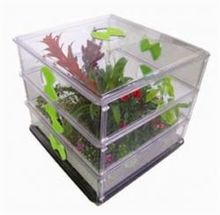
Indoor Gardening -SHOWING THE MOST SUCCESSFUL TREATMENT FOR ALL PLANTS CULTIVATED IN THE GREENHOUSE
IN-DOOR GARDENING FOR THE MANY.
JANUARY.
FIRST WEEK.
GREENHOUSE AND CONSERVATORY.
CINERARIAS.—The plants intended for large specimens must receive their final shift, and be allowed sufficient space to expand their foliage without interfering with or injuring each other. The side-shoots to be tied out.
EPACRISES.—As some of them will be preparing to burst into flower, a little arrangement may be necessary in tying them out to display their spikes of bloom more advantageously.
FUCHSIAS.—If wanted early, the plants that were first put to rest should be selected, and be fresh potted, cutting back the roots, beginning with a small-sized pot; to be shifted into larger when the roots have extended to the outside of the ball. Place them in a nice moist temperature of 50° by day and 40° by night.
HEATHS.—To be looked over, and the dead and decaying leaves removed. The most forward in bud—such as the Vestitas, Vernix, Vasciflora, Aristata, Beaumontia, and many others, to be tied out, and arranged for the season.
PELARGONIUMS.—When large specimens are wanted, tie out the branches at equal distances, and down as near to the rim of the pot as possible. Air to be given at all favorable opportunities. Water to be given but sparingly, and not overhead.
STOVE AND ORCHID-HOUSE.
Be careful that the night temperature is not raised too high: if kept at 50° in severe weather no ill consequences will result. The atmosphere to be kept rather moist, especially if the weather is bright; and all plants indicating an appearance of starting into bloom to be removed to the warmest part of the house.
CLERODENDRONS.—To be shaken out of their pots; their roots reduced and re-potted into small pots in a light sandy loamy compost. Sow seeds, and also of any hard-wooded stove plants.
Water to be given very cautiously to the Orchids, merely sufficient to prevent the plants from shriveling; and to do this effectually it is necessary to look over them every day. The air of the house to be kept moist by sprinkling the pathways, floors, tables, &c., daily.
If any plant is found not to have ripened off its bulbs it should be placed in the warmest part of the house, and the ripening process encouraged. The Brassias, Cyanoches, Coelogynes, Miltonias, and other such plants, when they are beginning to grow, to be re-potted. The compost to consist of turfy peat mixed with a portion of charcoal or broken potsherds, and the pots to be at least half full of very open drainage.
FORCING-HOUSES
CHERRIES.—Very gentle excitement to be given by fire or artificial heat, with kindly humidity, and abundance of air.
FIGS.—Although they will bear a higher degree of temperature without injury than either Cherries or Peaches, it is advisable to begin cautiously, as it frequently happens that the more haste with fire the less speed with fruit, and that favorable opportunities of sun and light must be embraced for making sure progress with them.
PEACHES.—Where the trees are coming into bloom it is necessary to be cautious in the application of humidity, and when they have expanded their flowers to withhold it altogether for a time. Fire or other artificial heat to be applied moderately—that is, from 45° by night to 55° by day, particularly when dark and gloomy weather prevails. The houses now commencing to force to be kept moderately moist, and in a sweet healthy state, syringing the trees pretty freely once or twice a-day with tepid water. Shut up early on sunny days, and sprinkle the paths, floors, flues, or pipes frequently.
VINES.—When they have all broken, the superfluous buds must be rubbed off, and the young shoots stopped as soon as they are long enough to admit the points of the shoots at one bud above the bunch being broken out. In vineyards now commencing to force, adopt the practice of producing, where it can be applied, a kindly humidity by means of dung and leaves, or other such fermenting materials. If they are to be broken principally by fire heat, either by flues or hot-water pipes, copious syringing must be resorted to with tepid water once or twice a-day. Fire heat to be applied principally by day, with air at the same time, and very moderately at night.
SECOND WEEK.
GREENHOUSE AND CONSERVATORY.
The plants will now require particular attention and a nice discrimination in the application of water: it may be comprehended by all persons interested in gardening operations, that when the soil on the surface of the pot looks damp it will not require water until it gets thoroughly dry at this season, and then it is to be given before the plant droops or flags for want of it.
But when the plant droops and the soil on the surface appears damp, the cause is then to be discovered by turning the ball out of the pot, when it will be seen whether the whole or only a portion of the soil is wet; as it sometimes happens, when fresh potted with light soil, it shrinks from the sides of the pot when dry, and when water is given it runs down and moistens the outside, without penetrating the ball.
The evil is corrected by holding it for a short space of time in a tub of water of the same temperature as the house. If the soil of any plant is sodden with water it should be turned out of the pot, and the drainage examined, and no water to be given until it becomes thoroughly dry.
VERBENAS.—They require to be kept tolerably dry, as they are more susceptible of injury from damp than from cold; a top shelf near the glass in the greenhouse is a very suitable place for them. If mildew appears, to be dusted with flowers of sulfur.
STOVE AND ORCHID-HOUSE.
Although all plants now at rest should be kept comparatively dry, they will require to be looked over daily to see that they do not suffer for want of water. The temperature not to exceed 60° by fire heat, and a fall of 10° may be allowed at night in very cold weather. Many of the stove plants—such as Aphelandras, Justicias, Poinsettias, &c.—may now be cut down altogether, and kept dry for a few weeks, which will cause them to make an early growth, and to come into flower a few weeks sooner next winter.
GESNERAS.—Select a few roots of them and a few of the Gloxinias to start into growth to produce a succession of flowers.
FORCING-HOUSES.
ASPARAGUS.—If the soil in the bed is dry, give it a liberal supply of water, so that it may descend to the roots, as nonproductive is sometimes caused by the soil at the roots being very dry when the top is kept moist by gentle watering.
BEANS (Dwarf Kidney).—Sow every three weeks, if a constant supply is wanted. Keep the early crops well supplied with water, and give them frequent sprinklings overhead, to prevent the attacks of red spider.
MUSHROOMS.—An abundance of water to be thrown about the floors. If the beds are dry, to be syringed with lukewarm water, applying it like dew at intervals for a few hours. Temperature from 50° to 60°, with air occasionally in favorable weather.
PEACHES.—Continue previous directions. The trees in bloom to be artificially impregnated, and the foreright shoots to be rubbed off a few at a time before they become too large. Currents of air to be carefully avoided, especially when the trees are in bloom, as they have been sometimes observed to sustain injury from the two end doors being left open for a short time. Air to be given at the top daily in favorable weather.
PINES.—As the days lengthen and the light increases the plants that are swelling their fruit should be supplied with a gradual increase of heat (from 65° at night to 75° or 80° in the middle of the day in clear weather), water, and atmospheric moisture; while others that are in bloom and starting into fruit require more air or more moderate temperature, care in watering and less atmospheric humidity. Some of the strongest succession plants that are grown in pots to receive their final shift, that they may make their growth for fruiting in May or June. In old-fashioned pits or houses, where the flues run near the tan-bed, the plants should be closely examined, as they are apt to be injured by fire heat in such a situation.
STRAWBERRIES.—A few dozens more pots may be placed in a frame where there is a gentle heat and an atmosphere more congenial to their healthy growth than in a house.
VINES.—When they have made shoots two or three inches long, the night temperature to range from 60° to 65°, with an increase of from 5° to 10° during the day.
Grab Your Copy For Only . . . $9.95 I know you will get something from this well written eBook!
Remember: Knowledge is power - And Great Knowledge is Powerful. When reading an eBook can
MOVE you - Isn’t that feeling worth the price of the wonderful read? ENJOY! APPLY! SHARE!
9.95
USD
InStock