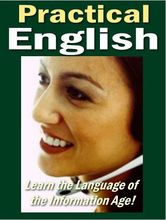
Practical English + French Language Phrases
Practical English + French Language Phrases
Digital Version Downloadable - No Shipping or Handling Fee!
Introduction by Author
From Bangalore to Bucharest, everybody is scrambling to learn English...
The Inaguage of the information Age. Are'nt you joining the bandwagon?
Learn English at Home & Master The Language of E-Commerce with this
practical English Language Course!
Dear Friend,
The art of using one’s native tongue correctly and forcibly is acquired
for the most part through imitation and practice, and is not so much a
matter of knowledge as of habit.
As regards English, then, the first duty of our schools is to set before
pupils excellent models, and, in all departments of school-work, to keep
a watchful eye on the innumerable acts of expression, oral and written,
which go to form habit.
Since, however, pupils come to school with many of their habits of
expression already formed on bad models, our schools must give some
attention to the special work of pointing out common errors of speech,
and of leading pupils to convert knowledge of these errors into new and
correct habits of expression.
This is the branch of English teaching in which this little book
hopes to be useful. All the “Exercises in English†with which the author
is acquainted consist chiefly of “sentences to be corrected.â€
To such exercises there are grave objections. If, on the one hand, the
fault in the given sentence is not seen at a glance, the pupil is likely,
as experience has shown, to pass it by and to change something that is
not wrong.
If, on the other hand, the fault is obvious, the exercise has no value
in the formation of habit.
Take, for example, two “sentences for correction†which I select at random
from one of the most widely used books of its class: “I knew it was him,â€
and “Sit the plates on the table.â€
A pupil of any wit will at once see that the mistakes must be in “himâ€
and “sit,†and knowing that the alternatives are “he†and “set,†he will
at once correct the sentences without knowing, perhaps, why one form is
wrong, the other right.
He has not gained anything valuable; he has simply “slid†through his
exercise. Moreover, such “sentences for correction†violate a fundamental
principle of teaching English by setting before the impressionable minds
of pupils bad models.
Finally, such exercises are unnatural, because the habit which we hope to
form in our pupils is not the habit of correcting mistakes, but the habit
of avoiding them.
Correct English is largely a matter of correct choice between two or more
forms of expression, and in this book an attempt has been made, as a glance
at the pages will show, to throw the exercises, whenever possible, into a
form consistent with this truth.
Though a pupil may change “who†to “whom†without knowing why, he cannot
repeatedly choose correctly between these forms without strengthening his
own habit of correct expression.
Practical English + French Language Phrases
These eBooks package Worth $84
Today's price $6.99
6.99
USD
InStock